
India's services sector activity moderated further in January as new business rose at a noticeably slower rate amid the escalation of the pandemic, reintroduction of restrictions and inflationary pressures, a monthly survey said on Thursday. The seasonally adjusted India Services Business Activity Index fell to 51.5 in January, down from 55.5 in December, pointing to the slowest rate of expansion in the current six-month sequence of growth. For the sixth straight month, the services sector witnessed an expansion in output.
India has been relatively insulated from the severe headwinds in the West. However, with a third of the global economy expected to slip into recession in calendar year 2023, the impact will strongly be felt on India's exports and trade economy, leading economists said in a panel discussion at the Business Standard BFSI Insight Summit in Mumbai on Wednesday. The panel comprised former Reserve Bank of India executive director and former Monetary Policy Committee member Mridul Saggar, State Bank of India Chief Economic Advisor Soumya Kanti Ghosh, Citibank India Chief Economist Samiran Chakraborty, ICRA Chief Economist Aditi Nayar, and IndusInd Bank Chief Economist Gaurav Kapoor. The topic of the panel discussion was No recession in sight: Is India decoupled from developed economies?
As the MPC is mandated to target CPI inflation rate at 4 plus minus 2 per cent, any measurement error in CPI is likely to have grave consequences for monetary policy.

'Concerns about India's future are hampering private investment.' 'If the private sector sees strategy, teams and execution on these issues, this will inspire confidence in India.' 'This should be our main strategy for 2017,' says Ajay Shah.
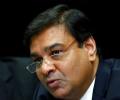
Lower inflation, FCNR(B) outflows likely to influence central bank decision

Consumer prices rose an annual 5.11 per cent (2012 base) in January.

India's economy will do well once vaccination reaches a critical mass as pent up demand, global recovery and easy financial conditions will boost activities, RBI's Monetary Policy Committee (MPC) member Ashima Goyal said on Tuesday.
The headline seasonally adjusted Nikkei India Composite PMI Output Index, that maps both the manufacturing and services sectors, rose from 53.3 in June to 54.1 in July.
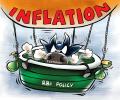
Analysts say RBI will cut rates because the liquidity crunch that began this time last year is still hurting the economy and also with an eye on the August industrial production numbers, which showed a contraction by 1.1 per cent -- the steepest in seven long years.

'The rising cost of construction, the cost of doing business, high compliance, and inflation/interest rates going up have already reduced returns to single digits.'

Fed keeps rates unchanged, sets up possible December hike

'He is positive and likes to get work done,' is how a retired bureaucrat described him. 'I assume he will push the reform agenda with strength.'

'We are very watchful about inflation and growth. But the main challenge is economic revival and growth.'

'Some of the astounding proposals, if translated into statutory provisions, would be suicidal.' 'This would not be a wonder cure for increasing insurance penetration and only result in mushrooming growth of players like paan kiosks with deleterious consequences.'

The Indian equity market is likely to remain under pressure and rangebound over the next few months. This comes as global central banks, led by the US Federal Reserve look at a possibility of hiking rates aggressively to tame inflation. Back home, the Reserve Bank of India, too, remains data dependent in its endeavour to keep inflation in check and pursue an aggressive monetary policy stance.

Given the various risks to growth, one could argue for rate cuts to be deeper than the 5 per cent terminal repo rate that we are projecting at this stage, says Kaushik Das.

There is a narrow chance that the central bank may cut rates in the future, according to a poll of 15 economists and treasurers.

'Banks are being encouraged to lend instead of parking their resources with the RBI and earn risk-free interest income,' points out Tamal Bandyopadhyay.

Services sector activities improved further and touched a five-month high in April driven by a surge in incoming new work orders that boosted business activity and supported a renewed increase in employment, according to a survey. The seasonally adjusted S&P Global India Services PMI Business Activity Index jumped to 57.9 in April, from 53.6 in March, highlighting a sharp rate of expansion that was the fastest since last November amid mounting price pressures. For the ninth straight month, the services sector witnessed an expansion in output.

S&P expects India to grow at 7.4 per cent in 2015, similar to the central bank's forecast for the fiscal year ending in March.
Chances of a rate cut in April improve if core inflation continues to ease, growth falling below the projected 7.2% for FY19 and if the global trade slowdown exacerbates.
By no means do economists see the Reserve Bank of India stop at just a 25-bp cut. Some of the economists such as Soumyakanti Ghosh of State Bank of India are of the firm view that rates have room to fall by a total of 75 bps in the current financial year, starting with 25 bps in the August 7 policy.

In a double delight, retail inflation eased to a one-year low of 5.72 per cent - staying below the upper tolerance limit for two months in a row, while factory output rose sharply to 7.2 per cent on the back of healthy growth in manufacturing. The retail inflation numbers based on Consumer Price Index (CPI) will provide some room for the Reserve Bank to further moderate the quantum of hike in key interest rate or even press a pause button. The RBI has been on a rate hiking spree since May 2022 in its bid to tame inflation, having raised the repo rate by a cumulative 225 basis points (bps).
North Block and Mint Road seem likely to now stick to the earlier convention of the RBI governor coming to Delhi and being the only MPC member meeting the finance minister and senior bureaucrats on pre-policy meetings

SBI was the top gainer in the Sensex pack, rallying over 10 per cent, followed by Kotak Bank, Dr Reddy's, UltraTech Cement, ITC and HDFC Bank. On the other hand, Axis Bank, Bharti Airtel, ICICI Bank, Maruti and HCL Tech were among the laggards.

A V Rajwade wonders if the Modi sarkar is pursuing price stability at the cost of potential social instability in both rural and urban India.
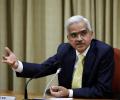
The Reserve Bank of India (RBI) on Friday decided to leave the benchmark interest rate unchanged at 4 per cent but maintained an accommodative stance, implying rate cuts in the future if need arises to support the economy hit by the Covid-19 pandemic.

Common use products like hair oil, soaps and toothpaste will be charged with a single national sales tax or GST of 18 per cent instead of present 22-24 per cent

'If the RBI now only prints Rs 100 in small denomination notes and the remaining amount is printed in Rs 500 and Rs 2,000 denominations, then by March-end the central bank can completely normalise the cash crunch situation.'

The Reserve Bank of India (RBI) on Wednesday announced to increase the policy repo rate by 50 basis points to 4.9 per cent, the second hike in five weeks aimed at quelling the inflation. The MPC vote was unanimous and has decided to keep stance withdrawal from accommodative, RBI Governor Shaktikanta Das said in a press conference on Wednesday. The decision was taken during a three-day meeting of the RBI's Monetary Policy Committee (MPC) to review the interest rates in the country. The MPC voted unanimously to increase the policy repo rate by 50 bps to 4.90 per cent," Das said.

There is nothing wrong with government and RBI having conflicting opinions.

Fed is still concerned about weak export growth.

The Nikkei Markit India Manufacturing Purchasing Managers' Index (PMI) -- a gauge of manufacturing performance -- fell to 52.3, down from October's 22-month high of 54.4.

'They can transition from short to long-duration funds when the yield curve normalises.'

The IHS Markit India Manufacturing PMI rose from 51.2 in November to 52.7 in December. Factories benefited from a rebound in demand, and responded by scaling up production to the greatest extent since May. As per the survey, new work orders witnessed marked improvement, with the pace of expansion picking up to the fastest since July.

'The no-rate cut policy and preference to wait for the Budget and clarity on the fiscal front demonstrate RBI Governor Shaktikanta Das is maturing in his new role,' notes Tamal Bandyopadhyay.

The central bank tweaked the retail inflation range to 4.8-4.9 per cent in the first half of 2018-19, and 4.7 per cent in the second half.

The Committee of Administrators (COA) on Saturday said the finance committee, which is currently headed by Jyotiraditya Scindia, will cease to exist once the new constitution of the Board of Control for Cricket in India is adopted.
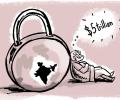
The wait for India to become a $5-trillion economic powerhouse by 2024-25 (FY25) is going to take longer than what the finance ministry had originally intended, according to the International Monetary Fund (IMF). The vision will instead be achieved in 2028-29 (FY29), reveals the IMF data, illustrating a four-year delay. Chief Economic Advisor (CEA) V Anantha Nageswaran had in February said India would become a $5-trillion economy by 2025-26 or the following year, on the back of 8-9 per cent sustained growth rate in real gross domestic product (GDP). However, the IMF data conveys that the economy will be $4.92 trillion in FY28, clearly alluding to the fact that the target will be realised in FY29.

Banks have raised concerns over the new international trade settlement in rupee, fearing that facilitation of such a mechanism could result in them facing the ire of economic sanctions by the West, people aware of the matter said. Large banks with overseas operations have sought clarity and assurance from the Reserve Bank of India (RBI) that they will not be targeted with sanctions for facilitating rupee trade with a sanction-hit country such as Russia. The present payment mechanism is a shift from earlier such arrangements, like the one with sanction-hit Iran, which involved banks facilitating settlement of international trade that did not have business in the sanctioned nation.
